重磅!SAT/ACT恢复强制提交!麻省理工官宣!
作者:网编整理 来源:新东方国际教育北京学校 发布时间:2022-03-30
疫情之下,国际生申请要求不断变化,也有很多消息在透露出美本申请似乎降低了要求,SAT/ACT渐渐淡出了大家的视线,也有很多同学在咨询小新,是否还需要将美国高考纳入自己的申请规划。
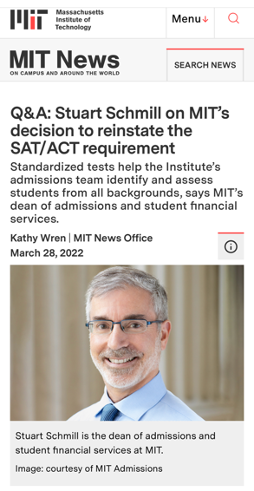
而如今的申请结果越来越体现出SAT/ACT成绩的重要性,3月28日,麻省理工大学官网正式官宣:SAT/ACT恢复强制提交!让我们来看看这所稳居美国TOP5的理工校天花板为何率先提出这项要求?
英文原文:
MIT Admissions announced today that it will reinstate its requirement that applicants submit scores from an SAT or ACT exam.
The Institute suspended its longstanding requirement in 2020 and 2021 due to the Covid-19 pandemic that prevented most high schoolers from safely taking the exams. However, with the advent of safe, effective pediatric vaccination, the expansion of the free in-school SAT (where most students now take the test), and the introduction of the digital SAT, most prospective students can take them again.
Research conducted by the admissions office shows that the standardized tests are an important factor in assessing the academic preparation of applicants from all backgrounds, according to Dean of Admissions and Student Financial Services Stuart Schmill. He says the standardized exams are most helpful for assisting the admissions office in identifying socioeconomically disadvantaged students who are well-prepared for MIT’s challenging education, but who don’t have the opportunity to take advanced coursework, participate in expensive enrichment programs, or otherwise enhance their college applications.
MIT News spoke with Schmill about how his team arrived at its decision, which he also wrote about today on the MIT Admissions blog.
Q: Why is MIT reinstating its SAT/ACT requirement?
A: First, let me talk a bit about why we have an SAT/ACT requirement in the first place. We have a dedicated research and analysis team that regularly studies our process and decisions. One thing they look at is what we need to predict student success at MIT. We want to be confident an applicant has the academic preparation and noncognitive skills (like resilience, conscientiousness, time-management, and so on) to do well in our challenging, fast-paced academic environment.
In short: Our research has shown that, in most cases, we cannot reliably predict students will do well at MIT unless we consider standardized test results alongside grades, coursework, and other factors. These findings are statistically robust and stable over time, and hold when you control for socioeconomic factors and look across demographic groups. And the math component of the testing turns out to be most important.
One reason we think this is true is because of the unusually quantitative orientation of our education, as I explain in more detail in my post. An MIT education combines deeply analytic thinking with creative hands-on problem-solving to prepare students to solve the toughest problems in the world. Our General Institute Requirements demand that all first-years must take (or place out of, through Advanced Standing Examination) two semesters of calculus and two-semesters of calculus-based physics, no matter what field they intend to major in; students who do not place out of physics also take a math diagnostic. In other words, there is no pathway through MIT that does not include a rigorous foundation in mathematics, mediated by many quantitative exams along the way. So, in a way, it is not surprising that the SAT/ACT math exams are predictive of success at MIT; it would be more surprising if they weren't.
I should emphasize here that we don’t focus only on the tests. In fact, we don’t care about the tests at all beyond the point where they — alongside other factors — help demonstrate preparation for MIT. We don’t prefer perfect scores, and a perfect score isn’t sufficient to say you’ll succeed at MIT, either. However, the tests are something we’ve found we usually need in addition to these other factors in order to demonstrate preparation.
We are reinstating our requirement in order to be transparent and equitable in our expectations. Our concern is that, without the compelling clarity of a requirement, some well-prepared applicants won’t take the tests, and we won’t have enough information to be confident in their academic readiness when they apply. We believe it will be more equitable — and less anxiety-inducing — if we require all applicants who take the tests to disclose their scores, rather than ask each student to strategically guess whether or not to send them to us.
Of course, we know that some students won’t be able to safely take the tests due to their own specific health conditions or various disasters and disruptions, as was the case before the pandemic. In these cases, we will allow students to explain on their application why they were unable to safely take the exam, and we will not hold the lack of exam against them. We will instead use other factors in their application to assess preparation as best we can, but with one less tool in our kit in their case.
Q: What do you say to those who argue the tests create structural barriers for socioeconomically disadvantaged and/or underrepresented students?
A: I appreciate this question, which we have kept foremost in our minds as we reviewed our research and policies. MIT Admissions has a strong commitment to diversity, and it is important to us that we minimize unfair barriers to our applicants wherever possible.
However, what we have found is that the way we use the SAT/ACT increases access to MIT for students from these groups relative to other things we can consider. The reason for this is that educational inequality impacts all aspects of a prospective student’s preparation and application, not just test-taking. As I wrote, low-income students, underrepresented students of color, and other disadvantaged populations often do not attend schools that offer advanced coursework (and if they do, they are less likely to be able to take it). They often cannot afford expensive enrichment opportunities, cannot expect lengthy letters of recommendation from their overburdened teachers, or cannot otherwise benefit from this kind of educational capital. Meanwhile, we know that the pandemic was most disruptive to our least-resourced students, who may have had no consistent coursework or grading for nearly two years now.
I realize this argument may sound counterintuitive to some who have heard that the SAT/ACT exams raise barriers for access, and I don’t want to ignore the challenges with, or limits of, the tests. They are just one tool among many that we use. However, what I think many people outside our profession don’t understand is how unfortunately unequal all aspects of secondary education are in this country. And unlike some other inequalities — like access to fancy internships or expensive extracurriculars — our empirical research shows the SAT/ACT actually do help us figure out if someone will do well at MIT.
It turns out the shortest path for many students to demonstrate sufficient preparation — particularly for students with less access to educational capital — is through the SAT/ACT, because most students can study for these exams using free tools at Khan Academy, but they (usually) can’t force their high school to offer advanced calculus courses, for example. So, the SAT/ACT can actually open the door to MIT for these students, too.
The key thing I hope people understand is that we are using the tests as a crucial tool in the service of our mission, and not for the sake of the tests themselves. If and when we can find better, more equitable tools than the SAT/ACT, we will make changes to our policies and processes, as we did a few years ago when we stopped considering the SAT subject tests. Our creative and dedicated research and analysis team will continue to work hard in this area.
Q: What do you think the impact of this reinstatement will be on your office and on MIT?
A: My hope is that it will help us recruit, select, and enroll a robustly diverse undergraduate student body that is well-prepared to succeed in our challenging curriculum. At least, when we presented our data and proposal to the Committee on Undergraduate Admissions and Financial Aid (CUAFA) — the student/faculty/staff policy committee that oversees our work — that is how we defined our goal, and CUAFA unanimously approved our plan on those terms.
Before the pandemic, considering testing (alongside other factors) helped us expand access to MIT, and we are very proud of the diversity and talent of the undergraduate student body. There is currently no majority race or ethnicity among MIT’s undergraduates. If you look at research published in The New York Times a few years ago, there is more economic diversity and intergenerational mobility at MIT than at comparable institutions; nearly 20 percent of our students are the first-generation in their family to attend college, as I was. We think that if testing helped us do this before the pandemic, it can help us continue to do it now. So, that is how we will evaluate success in the years to come.
由于疫情妨碍了大多数高中生安全参加考试,麻省理工大学在2020年和2021年暂停了对于SAT/ACT考试的要求。然而,疫苗接种的普及,大多美国本地的高中生以及国际学生都已逐渐恢复参与SAT/ACT考试。
招生办公室进行的研究表明,标准化考试是评估来自不同背景的申请人的学术准备的重要因素,招生和学生金融服务院长Stuart Schmill表示,标准化考试最有助于帮助招生办公室识别背景上不存在绝对优势的学生真实的学术水平,这些学生为麻省理工学院具有挑战性的教育做好了充分的准备。
文章中,招生官们这样说道:
“我应该在这里强调,我们不仅仅关注测试。事实上,我们根本不关心这些测试,除了它们与其他因素一起帮助证明麻省理工学院的准备工作之外。我们不喜欢满分,满分也不足以让你在麻省理工学院取得成功。但是,我们发现除了这些其他因素之外,我们通常还需要这些测试来展示准备工作。
我们正在恢复SAT/ACT的要求,以便实现录取的透明和公平。我们担心的是,如果没有令人信服的要求明确性,一些准备充分的申请人将无法参加考试,我们也没有足够的信息来确信他们在申请时的学术准备情况。我们相信,如果要求所有参加考试的申请人提交他们的分数,而不是要求每个学生根据自身的情况和信息来猜测是否要把他们发送给我们,那将更加公平,而且不会引起焦虑。“
那么,针对这一政策的更新,新东方对于不同年级的同学提出以下的建议:
高二在读的学生SAT考试、ACT考试备考建议
麻省理工率先提出这一项要求之后,相信也会有更多TOP30的院校跟上脚步,重新提高标化成绩的提高要求,让现在高二的学生多少有点措手不及。距离早申请提交还有最后7个月的时间,建议高二普高生在脱产期间尽快安排ACT的高强度学习,争取在6月、7月、9月,最迟在10月、12月完成ACT的考试。如果是国际班的学生,春季还是要关注校内的成绩和学科的大考,那么暑假的时间也就尤为关键了,5月大考结束后尽快进入ACT的学习节奏,争取赶上7月首考,并在9月拿到理想的分数。
高一在读的学生SAT考试、ACT考试备考建议
如果之前没有打算规划SAT/ACT规划的同学,现在一定要抓紧时间把托福的成绩拿到手了!如果受疫情影响有考位的取消,也建议尽快参加托福在家考的线上考试,达到托福85~90分的水平即可衔接SAT/ACT的准备。建议暑假可以完成一轮的学习,并在9月首考,这样高二也会有更充足的时间应对校内的学习、各项标化的刷分、以及更多竞赛活动的充实。
初三准备进入美本路径的学生SAT考试、ACT考试备考建议
可以多参考前几届有SAT/ACT考试成绩的学长学姐的规划路径,近两届的规划可能不一定适用于之后的学生啦。建议在进入高一之前尽快开始语言考试的学习,留出更多的空间提升自己的英语实力,以更高的水平去应对美国本地生所参与的这一项美国高考。
(责任编辑:admin)